
SBAN Releases New Case Studies on Community Ownership Strategies

 The Small Business Anti-Displacement Network (SBAN) has released a new collection of case studies on community ownership strategies to keep small businesses in place. Six organizations share how they created innovative models that provide stability for local small businesses, preserve affordable commercial property, and give low-wealth communities control of their neighborhood assets.
The case studies showcase programs, policies, and financial mechanisms that facilitate individual and collective property acquisition in diverse communities across the country. These include commercial land trusts, community investment funds, commercial property loans, land use policies, nonprofit property acquisitions, and small business incubators that provide affordable vending space.
Mission Economic Development Agency (San Francisco) – “Cultural Placekeeping Through Community Ownership in San Francisco’s Mission District”
Women’s Opportunities Resource Center (Philadelphia) – “Commercial Real Estate Acquisition Lending as an Anti-Displacement Strategy: Community Ownership Along Philadelphia’s Neighborhood Business Corridors”
The Miami Foundation (Miami, Florida) – “Rooted in the 305: The Miami Open for Business Collective Real Estate Ownership Fund in Miami-Dade County”
Mangrove Flatbush Central (Brooklyn, New York) – “Cultural Anchor Preservation as a Community Ownership Strategy in Brooklyn: Mangrove Flatbush Central Caribbean Marketplace and Incubator”
Partnership in Property Commercial Land Trust (Minneapolis) – “Partnership in Property Commercial Land Trust: Preventing Displacement of BIPOC Entrepreneurs in the Minneapolis–St. Paul Region”
Little Tokyo Community Impact Fund (Los Angeles) – “Own It to Control It: Little Tokyo’s Fight to Sustain Local Businesses by Mobilizing Small Investors in Community-Owned Real Estate”
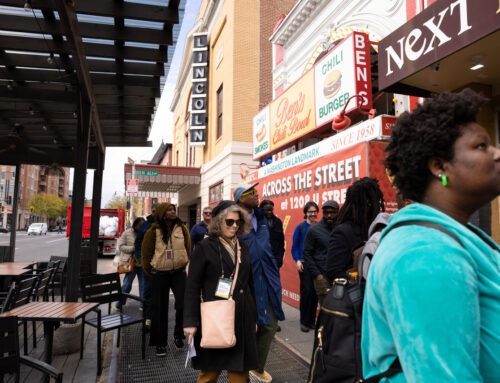
More and more communities across the United States and abroad are exploring community ownership as a long-term anti-displacement strategy. Historically, it has been used primarily to preserve or create affordable housing, and most examples of community ownership are residential. However, advocates are adapting residential models for commercial purposes to support local entrepreneurs. SBAN members, staff, and leadership had the chance to see such efforts first-hand at site visits hosted by author organizations Mission Economic Development Agency and Partnership in Property Commercial Land Trust earlier this year.
“Commercial community ownership is having a moment,” says SBAN Director Dr. Willow Lung. “The organizations featured in these case studies are leading the way, showing how it can be done—but also how being deeply embedded in the communities they serve is key to success.”
SBAN’s case study program provides organizations with grants to document promising, timely small business anti-displacement strategies. Case study authors learn from other awardees, receive consultant support from SBAN, and present their work to the network and other stakeholders at SBAN events. SBAN also selects two organizations to host site visits. In 2026, SBAN will release case studies on strategies to combat climate displacement.
About SBAN: The Small Business Anti-Displacement Network is a network of more than 185 organizations across the United States and internationally that work to prevent displacement of BIPOC- and immigrant-owned small businesses in gentrifying neighborhoods. Housed at the University of Maryland’s National Center for Smart Growth, SBAN includes policymakers, nonprofit advocates, technical assistance providers, real estate developers, financial institutions, scholars, and small business owners, who share knowledge and collaborate to advance innovative policies and practices that keep small businesses in place.
PHOTO: Small business Medina’s Body Care on the plaza at Flatbush Central Caribbean Marketplace in Brooklyn, New York.